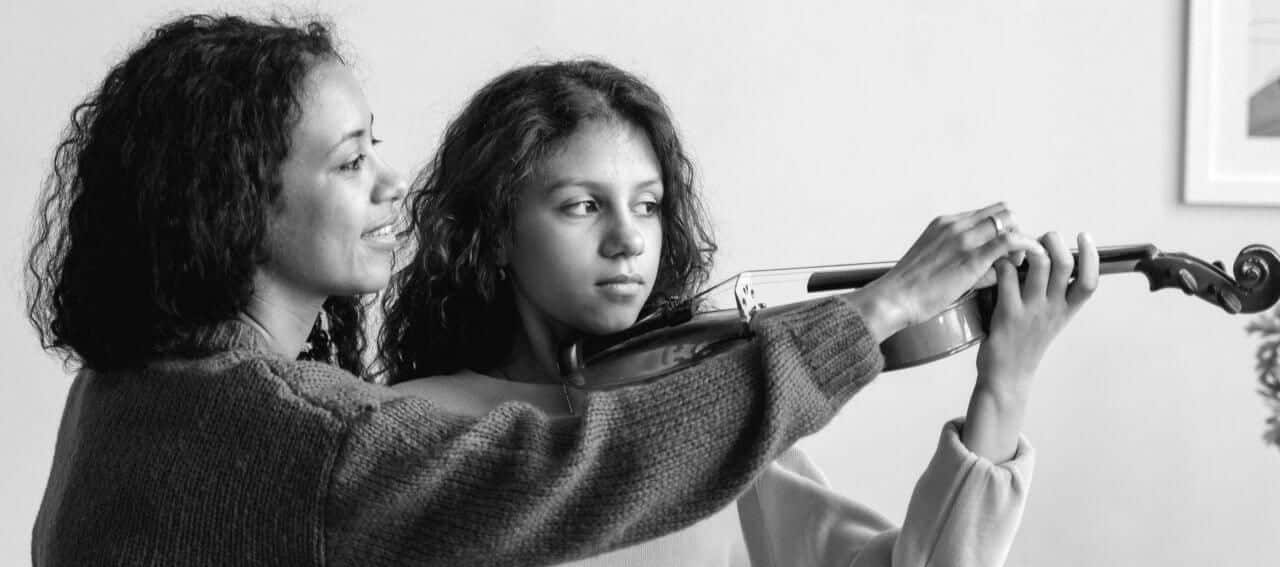
Part 2 of a five-part series on supporting your child’s music practice at home.
What Children Actually Remember: The Parent–Child Bond in Practice
When we think about what children might remember from their musical upbringing, it’s easy to picture the big milestones — recitals, polished pieces, or the moment they finally master a tricky passage. But when adults look back on their childhood music years, the memories that rise to the surface are usually much simpler.
They remember who sat beside them.
They remember the parent who showed up every day, even when the practice was messy. They remember the calm voice, the steady presence, the small celebrations, and the quiet reassurance during moments of frustration. They remember feeling accompanied.
In the Suzuki approach, this bond is not an extra. It is part of the method’s structure — a daily expression of love, trust, and togetherness woven into the process of learning music.
What Stays With a Child
Technique comes and goes. Pieces are learned, performed, and replaced. But the emotional imprint created during practice lasts much longer.
A child learns:
- “My parent shows up for me.”
- “I matter even when I struggle.”
- “We can figure things out together.”
These lessons sink deeper than any scale or bow hold. They form the inner framework a child carries into all future learning.
One former Suzuki student remembers crying over tenor clef as a child. She can no longer recall the notes her father helped her play — but she vividly remembers him sitting beside her in pajamas, clarinet in hand, saying gently, “Try again.” Years later, that’s the part that stayed: feeling valued, supported, and not alone.
Practice as a Space of Connection
Daily practice creates a rare structure in family life: regular one-on-one time, free of distraction, linked to growth.
It is a ritual that says:
- “I am with you.”
- “I am not in a hurry.”
- “We can take this one small step at a time.”
Even on the difficult days — perhaps especially on the difficult days — this message takes root. Children do not remember whether every practice went smoothly. They remember how it felt to face challenges with someone beside them.
How Parents Shape the Atmosphere
You don’t need to be a musician to make a difference. You don’t even need to know the correct fingerings. Your real influence comes from the emotional tone you bring into the room.
Small choices matter:
- Laughing off a squeaky note
- Noticing effort (“I saw you really try that again.”)
- Staying calm when things feel stuck
- Taking a short break instead of pushing through frustration
- Sitting close and listening
These actions teach a child that difficulty is normal and that support does not disappear when things get challenging.
Over time, the practice room becomes a place where a child learns to trust themselves — because they first learned they could trust you.
The Gift You Are Giving
Long after your child finishes Book 1 or Book 10, long after they graduate or move into other pursuits, this is what remains:
the sense of being valued, accompanied, and encouraged.
It becomes part of who they are.
And one day, when they look back, the memory won’t be “my parent corrected my bow hold.” It will be something much simpler and much more enduring:
“My parent sat with me. They stayed. And that made all the difference.”
Next in Part 3, we’ll explore how motivation develops over time — and how parents can nurture the shift from external support to internal ownership.